Custom prompts
Effective prompts, tailored ideally to your business.
Large language models (LLMs) can be flexibly adapted to meet company-specific requirements. Rather than spending a great deal of time and money training a model, specifications from style guides, linguistic factors and known sources of error can be taken into account through targeted prompts.
oneword combines linguistic and technological expertise and develops custom prompts that are perfectly tailored to your content and requirements. This is how we generate bespoke AI translations and can continually reduce the amount of post-editing required.
Our certifications:



What Language AI means at oneword
How well an LLM performs in terms of translation depends largely on the instructions it is given. With custom prompts, we create bespoke instructions for your own LLMs or our locally hosted ones. In the process, we take into account your corporate language, your content and your specific quality requirements.
To do this, we analyse:
These sources form the basis for your custom prompts. We assess their effectiveness during post-editing and in future projects. This is because we view custom prompts as a dynamic process for continuously improving the output of AI systems.

How our custom prompts work
1
Analysing requirements
We analyse style guides, terminology, translation data, common sources of error and specific requirements.
2
Developing prompts
Based on these findings, we develop customised specifications for the LLM being used.
3
Testing the results
The prompts are tested using actual translations and checked during post-editing.
4
Making use of feedback
Corrections and sources of error identified in projects are incorporated into the further development of the prompts.
Which translation processes are custom prompts suitable for?
Custom prompts are particularly useful when similar content is translated on a regular basis and specific linguistic requirements need to be taken into account. Particularly when standard models fail to achieve high levels of reliability in implementing certain specifications or linguistic details, custom prompts can be used to achieve specific improvements.
Examples of use:
- Content with specialist requirements and specific terminology, such as marketing translations, technical documentation, software localisation or the translation of product information
- Recurring and predefined wording and specifications that standard models do not have sufficient reliability to implement
- Common sources of error in AI translations
- Content and specifications that are regularly adapted or further developed
Would you like to know whether your translation process can be optimised using custom prompts? We analyse your specifications and show you where and how you can reduce the amount of post-editing work required through targeted prompting
The reasons why custom prompts are worthwhile for your business
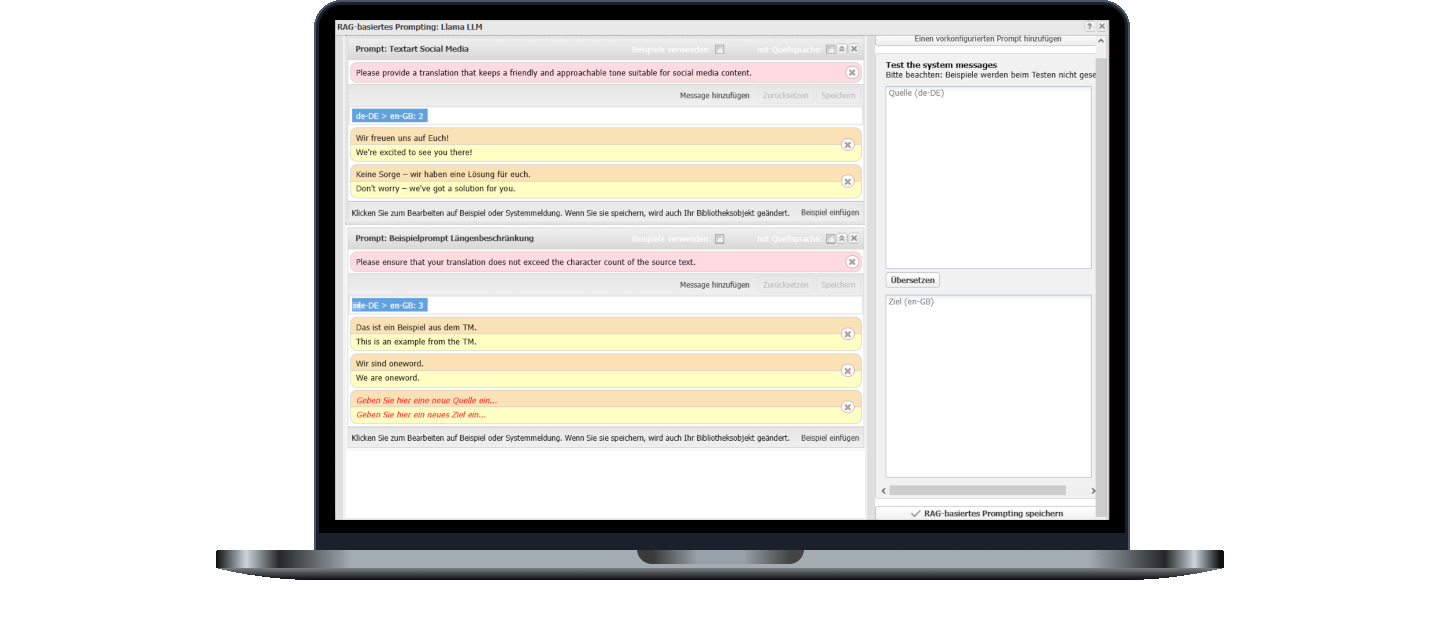
Using custom prompts in a computer-aided translation tool
For translation processes to be efficient, AI and custom prompts must be seamlessly integrated into the translation environment. With our oneAI service, part of our oneSuite language technology platform, you can benefit from bespoke AI translations directly within your translation workflow.
FAQs
How can I tailor an LLM to my business?
An LLM can be adapted to company-specific requirements through targeted prompting. Custom prompts provide the AI system with specific instructions for the translation, e.g. regarding style, terminology, particular wording or common sources of error. The specifications can be defined for individual target languages or across all languages.
What can I control using custom prompts?
Custom prompts can be used to control a wide range of linguistic and content-related parameters. These include, for example, style and tone, terminology, preferred wording, spelling conventions, the requirements of the target audience and common sources of error. Specific instructions set out in style guides, post-editing guidelines or other company policies can also be taken into account.
Custom prompts or fine-tuning – what’s the difference?
With custom prompts, the LLM’s output is tailored to your requirements through specific instructions. Fine-tuning, on the other hand, modifies the model itself by continuing to train it using additional training data. Custom prompts are generally quicker and more flexible when linguistic specifications, terminology or common mistakes need to be taken into account. oneword supports you with both these processes: with custom prompts, we develop the prompts; with fine-tuning, we take care of selecting and preparing the training data.
Do I have to create my own custom prompts?
No, the team at oneword takes care of that. First, we review your specifications and identify any previous sources of error. We then convert all the information into appropriate prompts for each language or across languages.
What are some good prompts for AI translations?
Good prompts take into account requirements that are relevant to your business and your translations. These include, for example, style guides, terminology, post-editing guidelines and documented sources of error. The key is to tailor them specifically to your linguistic requirements and specific circumstances. Good prompts produce AI translations that require significantly less post-editing.
How time-consuming and expensive are custom prompts?
The effort and costs involved depend on your requirements and the existing database. Even just a few carefully designed basic prompts can improve the quality of AI translation output if they specifically address common sources of error. On this basis, oneword gradually refines prompts to continually reduce the amount of post-editing work required in the long term.
Do you only need to run custom prompts once or on a regular basis?
A solid foundation for custom prompts, which takes into account existing specifications and known sources of error, is the first crucial step towards company-specific AI translations. However, with each project, further insights and specifications may arise. That is why we analyse the results regularly and refine the prompts as necessary to reduce the error rate of the AI.
How can I use custom prompts in my computer-aided translation tool?
That depends on your computer-aided translation tool. Not every CAT system supports the integration of prompts into LLM-based translation processes. We will assess your existing system landscape and show you how custom prompts can be integrated into your existing workflow or which solution is best suited to this.
Our AI translation services.



Let’s discuss your next project!
Please use our contact form or give us a call:
Make an appointment now: